
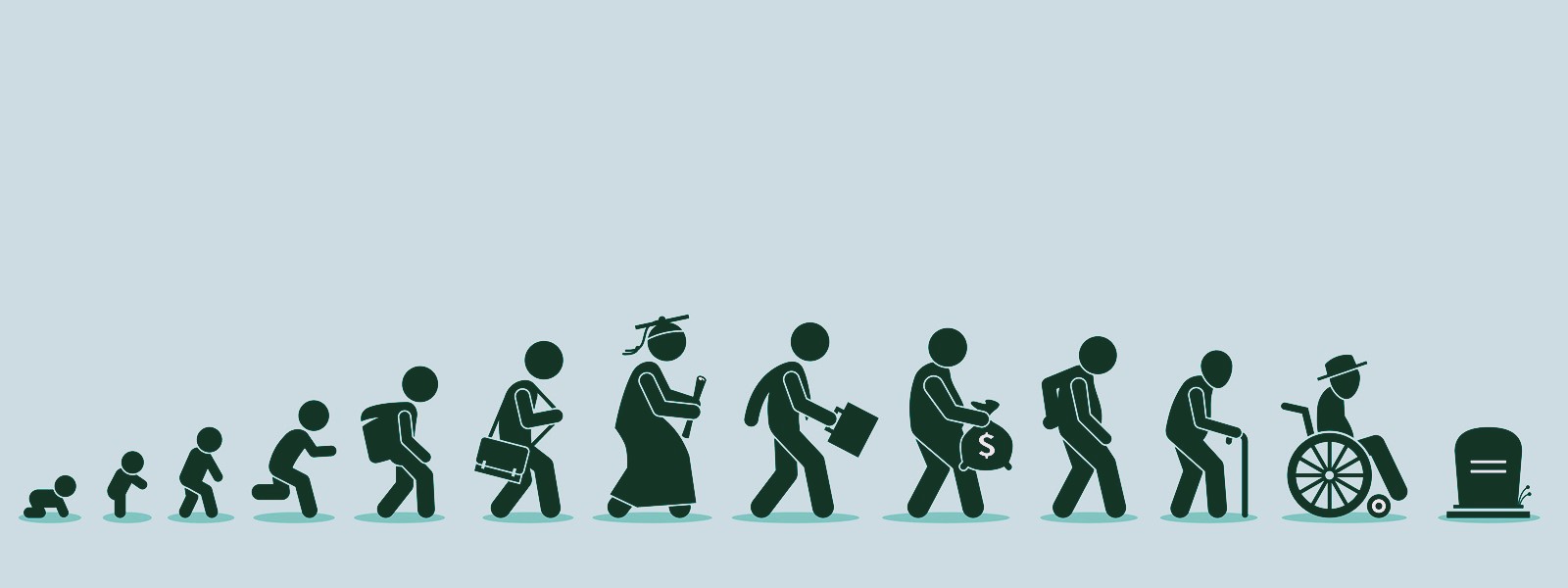
We are getting older and older from generation to generation.
If this increase in our life expectancy continues, around half of those born today will live to be 100.
„Our Lifespan has almost doubled in the past hundred years, with the Health margin nothing has changed - despite all the medical advances,“ says Dr Michael Spitzbart, a renowned specialist in preventive medicine.
So are we getting older and older, but not really healthier in old age?
Is modern medicine keeping us alive longer and longer thanks to early diagnosis and support from drugs, equipment and surgery, without really improving our quality of life?
The fact is that ageing is accompanied by a decline in many physical functions and the degradation of some structures - which few people find pleasant. This can be delayed, but not stopped.
Over 2000 years ago, Ayurvedic medicine described a paradox of life: although our body degenerates, our mind can mature - and thus also slow down and neutralise ageing physically.
However, this longed-for form of ageing is not a matter of course. A number of conditions must be met for it to succeed.
-
Physical characteristics of ageing
Gerontological experts generally distinguish between four phases of life: Phase 1 stands for childhood and adolescence, Phase 2 covers about 40 years as an adult, the third age begins at the age of 60 and that fourth at around 80 until death.
In the first forty years of life, disturbing and stressful signs of ageing are rarely noticeable. Between 40 and 60, a significant hormonal change begins in which we set the course for our old age. The third age is then definitely accompanied by degradation processes and the fourth is mostly characterised by multimorbid realities.
If we look at ten important organ systems, the following characteristics become apparent with increasing age:
- SkinDecrease in elasticity and firmness, increase in wrinkles and spots
- MusculatureReduction of muscle mass, increase in connective and fatty tissue
- BonesReduction in bone density, cartilage and elasticity
- Cardiovascular systemPoorer blood circulation, higher blood pressure, lower adaptability (HRV), increasing heart failure
- AirwaysReduced elasticity and oxygen absorption capacity
- Energy metabolismReduced basal metabolic rate and decrease in glucose tolerance
- Immune systemWeaker defence against infection, slower wound healing, increase in immune deficiencies
- Endocrine systemDecrease in all rejuvenating hormones (STH, DHEA, melatonin, etc.), increase in the stress hormone cortisol
- Sensory organsDecrease in all sensory functions
- Nervous systemDegradation of neuroplasticity and cognitive functions
How do you feel when you read the words decline, degradation, reduction, weaker, worse, slowed down? Unfortunately, this sounds like an unattractive, rather deficient physical outlook on old age.
-
The Ayurvedic perspective on ageing
Ayurveda is the oldest documented teaching on healthy ageing.
Ayus means longevity and Veda is the knowledge of how we can reach old age with few complaints, full of meaning and happy. This goal is at the heart of Ayurvedic life science.
Childhood is characterised by the growth-controlling Kapha which, during puberty, transforms into the hormonally active Pitta transitions. Adulthood is governed by fiery Pitta and its powerful transformation, and goes into a phase of transition during the menopause. Vata about. From our mid-50s or early 60s, Vata accompanies us until the end of our lives and is responsible for the degenerative processes mentioned above, which are mainly due to increasing dryness and cold.
The 100 postulated years of life are divided into ten decades in the classical writings, and the expected loss of physical, sensory and mental abilities is described for each one.
To prevent complaints in old age, all qualities and functions of Vata must be controlled - the earlier we start, the better. There are numerous nutritional and lifestyle options available to us for this purpose.
-
The paradox of life
While our body gradually degenerates with age due to increasing Vata, our mind can undergo the opposite evolution.
Kapha, Pitta and Vata are the three forces of our body. Body, which dominate our three main phases of life.
In the Spirit Tamas, Rajas and Sattva describe three characteristics that are individually developed depending on our thoughts, feelings and behaviour.
Basically, in early childhood we are Tamas Our perception is not yet fully developed and we do not yet understand many connections. The physical phase of life dominated by Pitta usually goes hand in hand with the passionate Rajas in the mind, which is characterised by black and white thinking and the two poles of attachment and aversion. The older we get, the more we question our lives and their meaningfulness. Now is the time of Sattva which gives us calm, peace, harmony and equanimity.
An Ayurvedically „successful“ life therefore goes hand in hand with spiritual development, which strongly influences our behaviour. Under dominant sattva, it is easier for us to accept physical ageing and manage our strength. We develop social skills that improve our mental well-being with increasing age and have been proven to prevent dementia.
Vata remains Vata, but rises in a milder way and burdens us significantly less.
-
Understanding and shaping ageing holistically
We age not only physically, but also mentally, socially and culturally - with major challenges.
Mental we often feel much younger than our body image reveals when we look in the mirror. The identity we developed at a young age requires an age-appropriate adjustment, which takes place much more slowly than we age physically.
The Social ageing is characterised above all by the loss of familiar contacts after an active working life and later also by the death of important life companions. Without new contacts, there is a feeling of isolation and a lack of connection.
Cultural Many people can no longer keep up with the rapid pace of development. The norms they have learnt no longer apply, they don't understand technology and the needs of young people are alien to them.
So our lives remain a great challenge even as we grow older. If we learn to use Ayurvedic methods to balance the increasing Vata, strengthen Sattva in the mind and thus develop a new altruistic identity, remain socially connected and culturally open to the development of the world, we will be well equipped to meet this challenge.
What could be better than being respected and needed by younger people with the experience of a long life? This is not an illusion. We ourselves decide whether it succeeds.
-