Buddha's teaching (Dharma) is uniquely valuable - and deeply psychological. The causes of suffering are three unwholesome roots viewed: Attachment, aversion and illusion. They give rise to fears, worries, envy, greed, jealousy and other „disturbing emotions“ from which we suffer.
The counterpart to these roots of unwholesome actions and thus remedies are the three healing roots Wisdom, love & compassion and generosity. They give rise to mental qualities such as trust, joy, clarity, strength and equanimity. Buddhist psychology aims to strengthen these healing qualities within us.
Four basic ideas of Buddhist psychology
Our spiritual orientation is the foundation of mental health.
The preciousness of our lives
Our birth as a human being is not just a gift, but a great opportunity and task.
We can learn, recognise and free ourselves from suffering. For a fulfilling, meaningful life.
Transience
We are born, age, fall ill and die. Nothing is of a permanent nature.
A deep understanding of this law of nature helps us to face suffering with acceptance.
Cause and effect
With our body, speech and mind, we are constantly sowing seeds that ripen into fruit.
At every moment, we have the opportunity to steer our lives in a desired direction.
Disadvantages of our holding on
The cycle of suffering is perpetuated by our clinging to the ephemeral
Liberation means joy and bliss beyond all mental conceptions.
Four noble truths - Buddha as a doctor
The four noble Truths form the basis of Buddhist psychology. They explain the foundation, path and goal.
Medical history
There is suffering.
Illness is an expression of suffering and the frustration that things in life are not the way we want them to be.
Cause research & diagnosis
Suffering has a cause.
What are the true causes of your ailments? All complaints can be causally assigned to spiritual origins.
Healing and therapy goals
There is an end to suffering.
Healing on a spiritual level is always possible, even if your body is ill. What would you like to free yourself from?
Holistic therapy plan
There is a way.
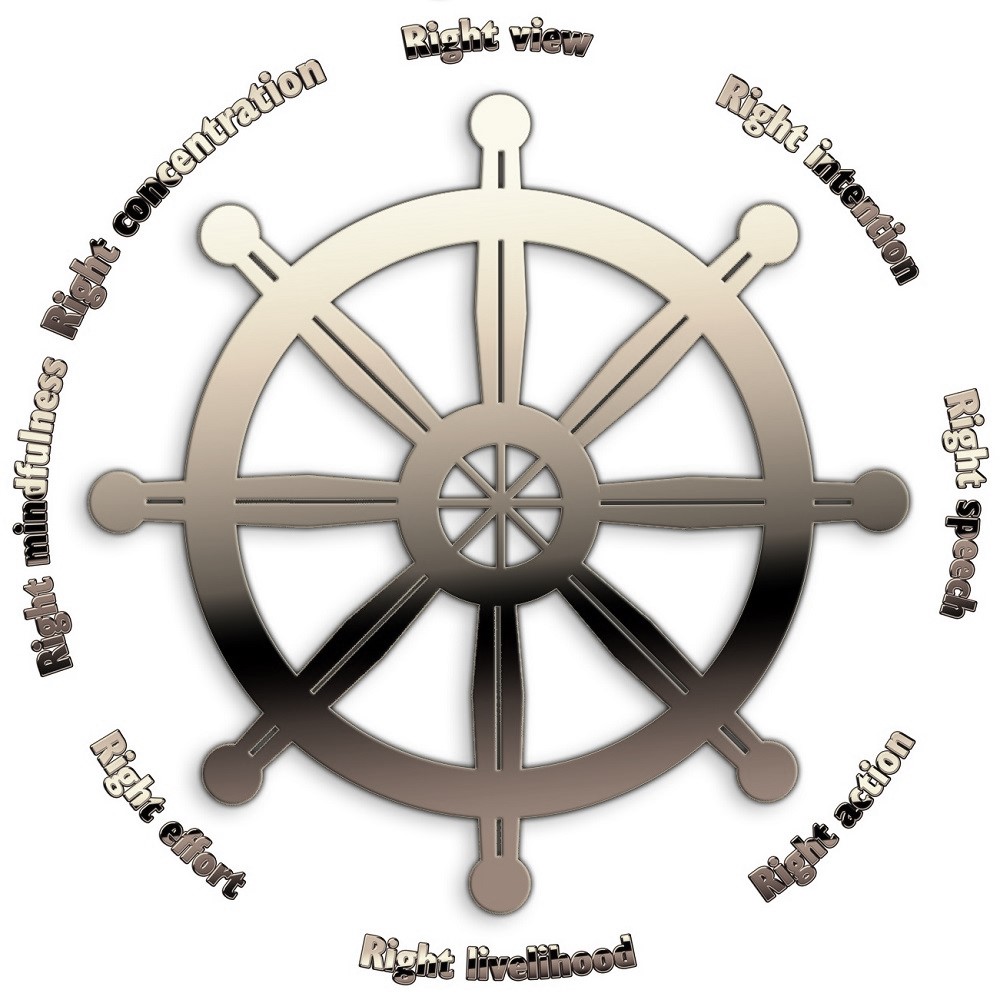
The noble eightfold path is a training path to liberation and overcoming suffering. It has a preventative and curative effect.
Noble eightfold path - path of the centre
The noble eightfold path is a middle way in which extremes are avoided for sustainable liberation from the cycle of suffering (vicious circle). It represents the „Buddhist prescription“ and offers valuable approaches to behavioural change in psychotherapy.
The eight links are:
right view,
right determination,
right language,
right action,
right livelihood,
right effort,
right mindfulness and
right concentration.
Meditation in Buddhist psychology
Meditation is the state in which subject (I), object (my focus) and action (my practice) become one.
Then we rest in our true nature.
Meditation is abiding without attachment.
There is nothing to achieve.
Meditation is the dimension of timelessness.
Meditation promotes mental balance by reducing anxiety, balancing emotional fluctuations, mental calm and serenity, clarity and insight.
Meditation as part of psychosomatic intervention
In our work, we first check whether meditation is a suitable tool for you to promote your mental health. There is no effective method without possible side effects and contraindications. This also applies to meditation, which is usually very well tolerated.
In the next step, we will introduce you to passive and active forms of meditation, from which we will select the most accessible for you at the beginning. We will practise these together and you will receive instructions (including audio) for practising them independently at home.
At EURASIAMED, Buddhist psychology is incorporated as desired.
If you are interested, ask about the possibilities of integrating it into your therapy, coaching or training.