
A journey to ourselves
What do Oprah Winfrey, Richard Gere, Tina Turner, Lady Gaga, Paul McCartney and football coach Thomas Tuchel have in common? They meditate.
More and more celebrities are swearing by the power of inner reflection and deep contemplation. American tech giants such as Google and Apple even offer their own meditation programmes and rooms for their employees.
Meditation has finally arrived in the West and its lasting effects are increasingly being scientifically researched and recognised.
Just a few years ago, meditation was mostly ideologically bound to traditions and spiritual communities, but it has become increasingly liberated and is now reaching more and more people as a mindfulness practice.
-
What actually is meditation?
There is still no universally valid, scientifically recognised definition for this.
It is about a conscious, value-neutral, mindful attitude in the present moment. Thoughts, feelings and sensations come and go without us holding on to them or pushing them away.
Meditation serves no „purpose“ in the classical sense of yogic and Buddhist schools. We learn to be aware without being aware of anything.
There are various meditation techniques - the psychologists Matko & Sedlmaier (2019) distinguish between the following seven:
- Meditation with movement (e.g. Japanese walking meditation)
- Body-centred meditation (e.g. BodyScan, breathing meditation)
- Mindful observation of thoughts, feelings and sensations
- Contemplation (reflecting on fundamental questions)
- Visual concentration on an external or internal object
- Affect-centred meditation (e.g. metta meditation)
- Mantra meditation (silent or loud repetition)
-
Why do we meditate?
Today's motivations for meditation are diverse, both secular and spiritual.
It often serves to better manage stress and regulate tension, high performers want to increase their performance through more focus, psychosomatic sufferers hope for symptomatic relief, those seeking meaning strive for self-knowledge. Many simply want more peace, serenity and well-being.
In therapeutic circles, we now even speak of specific indications and contraindications.
-
Dimension of timelessness and non-doing
Our modern Western society is characterised by performance thinking and time pressure. We often transfer the economic cost-benefit calculation to our private lives and strive for success, impact and measurable results there too. But life means much more than that.
Meditation provides the urgently needed counterpoint here. We enter the dimension of timelessness, without beginning or end, without any claim to effect or benefit. If physical and mental benefits materialise, that's great. If not, that's just as good.
Meditation means non-doing. We merely create a framework in which whatever comes and goes, comes and goes. Without controlling, without influencing, without judging or condemning. This inner attitude is deeply liberating and has a lasting effect on everyday life.
-
This is how it can work - step by step
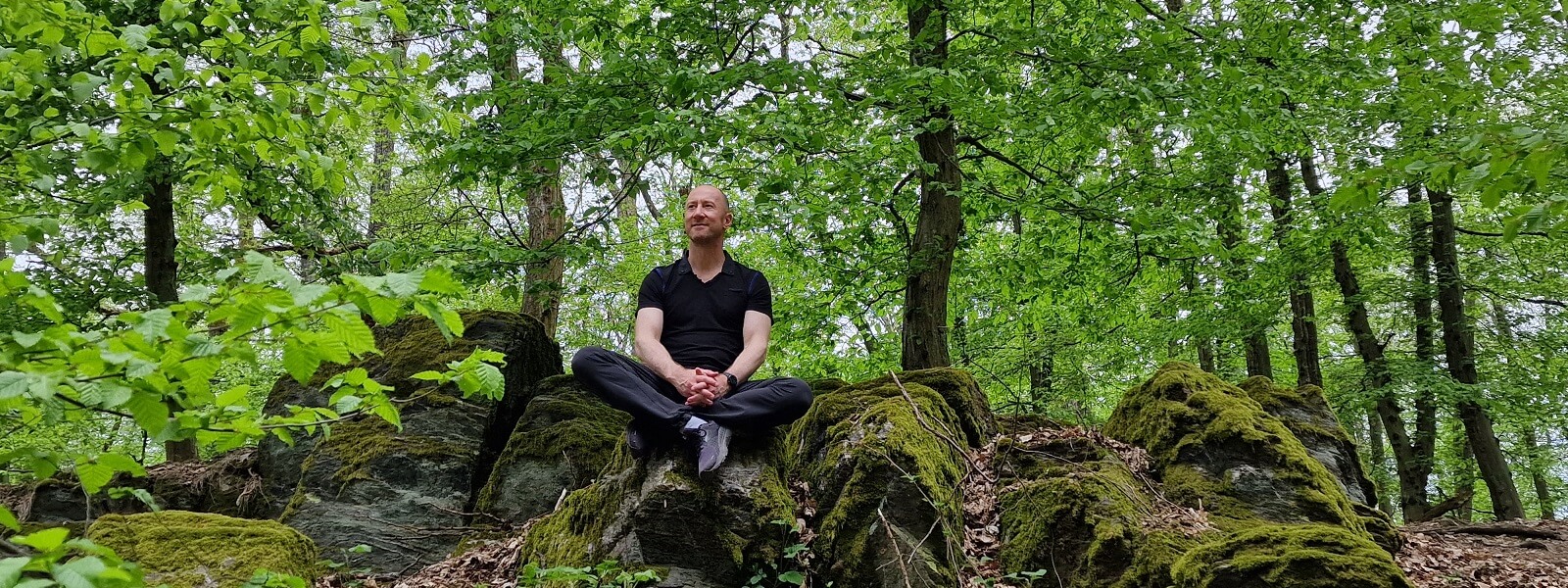
In my experience, the best introduction to meditation practice is breathing meditation, which I will show you how to try out below.
Choose a time of day when you can practise undisturbed and without time pressure. Experience has shown that early in the morning after getting up is best, but the evening is also suitable. Allow at least 15 minutes to achieve an initial depth.
Step 1 - Assume sitting position
Sit comfortably on the floor and use a seat cushion to make it easier to bring your knees to the floor and straighten your upper body. If you experience any discomfort, it is better to choose a chair without a backrest and sit upright on the front edge.
Find a position for your legs in which you can sit comfortably for at least 15 minutes with your upper body straight. In this position, put all your weight downwards.
Step 2 - Direct attention inwards
Now close your eyes and turn your attention from the outside to the inside. How are you feeling right now, how do you feel? Do you notice any tension or anxiety? If so, where exactly? Observe these unpleasant sensations without trying to influence them. They are now part of your experience, which we call meditation.
Step 3 - Observe your breath
Now focus on the breath that comes and goes at the tip of your nose. Feel the fresh, cool air as you breathe in through your nose and throat and the warm air as you breathe out. Also notice how your abdominal wall rises and falls and how your chest expands and contracts. Now let your attention wander from your nose to your chest and abdomen and back again - spontaneously and effortlessly.
Step 4 - Let thoughts pass by
Even with the best concentration on the breath, thoughts, feelings or physical sensations regularly occur that distract us. This is completely normal and part of your experience. Imagine your thoughts as clouds in the sky - they arise there, pass by and dissolve again. The sky is our mind, where everything arises and passes away. Our problem is not the thoughts, but our identification and preoccupation with their content. If we simply accept them as they are, they usually disappear much faster than we think.
With increasing duration, a feeling of calm, inner peace and weightlessness often arises between the thoughts. Enjoy this and stay in it for as long as it is possible and pleasant.
Step 5 - Arrive in the here and now
Now gently come back and become aware of your body as it sits here in this room. Breathe in and out a little deeper again, move your hands, stretch and stretch and then open your eyes again. Perhaps you would like to reflect for a moment, feel gratitude for what you have experienced or focus on the tasks ahead of you.
-
Beware the ego trap!
I used to be successful, healthy and fit - now I'm also spiritual. That's what many meditators think after a few months of practice.
In some Buddhist and yogic traditions, intensive tantric practices are carried out, which can be accompanied by strong energetic or mystical experiences. Some people use these to judge whether their practice was good and deep. This is an ego trap.
Meditation doesn't make us better, it makes us more aware!
Try it out right away.
-