Home page » Private practice » Psychotherapy » Acceptance and commitment therapy
Psychotherapy
Acceptance and commitment therapy
- Mindfulness-based behavioural therapy
- Mental flexibility is the key
- Transdiagnostic approach
- Our specialisations: Anxiety disorders, depression, eating disorders and somatoform disorders

Open up! Be present! Do what matters!
Mental flexibility defines ACT founder Steven C. Hayes as „our ability to be fully in touch with the present moment without defence or avoidance“.
Three myths about happiness are widespread:
Wrong!
Of course, the constant flow of emotions.
They come into being, exist and pass away.
Wrong!
Happiness means, to lead a rich, fulfilling and meaningful life. Also with stressful feelings.
Wrong!
If you are not happy, you are normal!
We all experience unhappy moments every day.
Mental inflexibility. Origin of many problems.
Our lives provide a wide range of emotions. Some of them - such as love, joy or curiosity - are positive. Others - such as fear, anger, sadness, shock, aversion or guilt - are negative. We struggle and fight with them day after day, sometimes even night after night.
The curious thing is that the more we fight against emotions, want to push them away or try to appease them, the more influence they gain over our thoughts, feelings, memories and actions.
In short: they are getting stronger, our fight is hopeless.

ACT Hexagon: Six processes to promote your mental flexibility
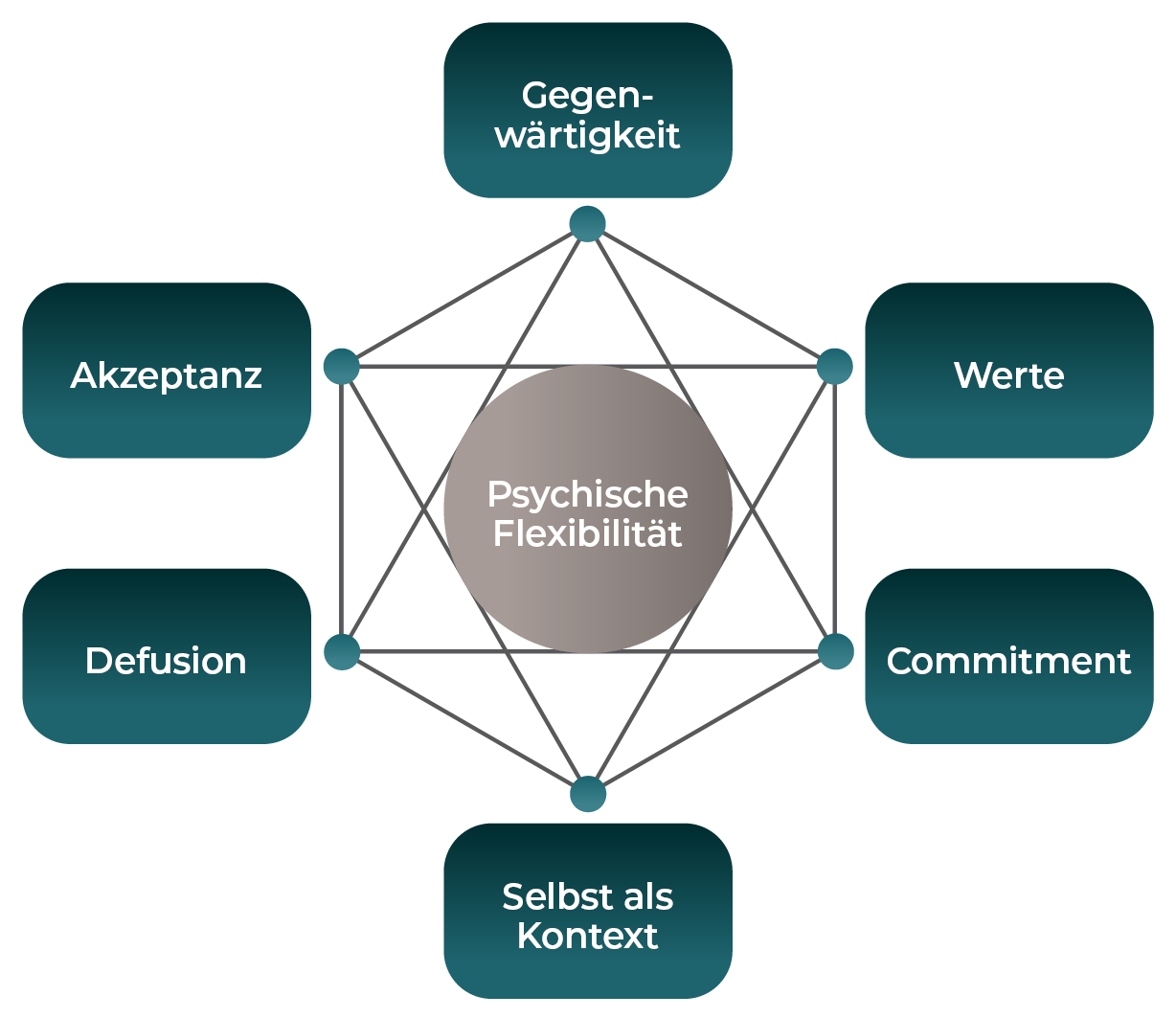
You are more than you think you are!
In our work, we jointly identify the core processes that make you inflexible and restrict your personal room for manoeuvre.
You will be given numerous exercises as an „antidote“ to strengthen the processes that promote flexibility:
- Cognitive fusion >>> DEFUSION
- Experience avoidance >>> ACCEPTANCE & READINESS
- Dominance of imagined past and future >>> PRESENT PRESENCE
- Lack of clarity about values >>> CLARITY OF VALUES
- Inaction and avoidance >>> ACTIVE ACTION
- Sticking to the concept itself >>> OBSERVER SELF
Defusion

In a state of fusion, we merge with our thoughts and emotions and behave rigidly and inflexibly.
Through defusion, we learn to perceive, observe, name and detach ourselves from thoughts and feelings.
Acceptance

In order to control unpleasant feelings, we often avoid triggering situations, suppress thoughts or numb ourselves.
Acceptance in the sense of inner acceptance and willingness is the only helpful alternative to unsuccessful control strategies.
Presence

Our mind tends to have an inner dialogue with memories of the past or fears about the future.
Living in the present moment is linked to our attention: as focussed concentration or expanded mindfulness.
Values

Values are at the heart of ACT and exploring, recognising and realising your values takes up a lot of space.
Values guide us like a compass in the direction of life and give our lives a deep meaning in the present moment.
Commitment

We can only influence thoughts and feelings to a limited extent. However, we have the choice of what we DO despite obstacles.
Active behaviour includes setting goals, solving problems, planning actions and practising skills. Proactive. Now.
Self as context

There is an instance within us that perceives: our observer self. From this place, we can observe our thoughts and feelings without influencing them and without allowing them to control us.
This change of perspective changes lives.
Indications for acceptance and commitment therapy

Who is ACT suitable for?
ACT follows a transdiagnostic approach and can therefore be used flexibly for a variety of psychological and psychosomatic complaints in all age groups.
Our experience extends in particular to the treatment of anxiety disorders, depression, eating disorders and somatoform disorders (especially pain disorders).
Psychosomatically, we work with ACT as required in our areas of specialisation Thyroid diseases, Internal medicine, Gynaecology and Skin diseases.
Procedure for Acceptance & Commitment Therapy
Building contact and trust
We are a team and treat each other with respect and as equals to achieve our common goal.
Diagnosis of your inflexibility
What processes prevent you from living a free life in line with your values?
Strengthening a willingness to accept
We replace avoidance of experiences and attempts at emotional control with inner acceptance.
Define behavioural goals
We turn our attention to your controllable behaviour. Who do you want to be? What do you want to do?
Plan actions, solve problems
We set goals and train skills for value-orientated, decisive action.
ACT Matrix. Towards or away from?
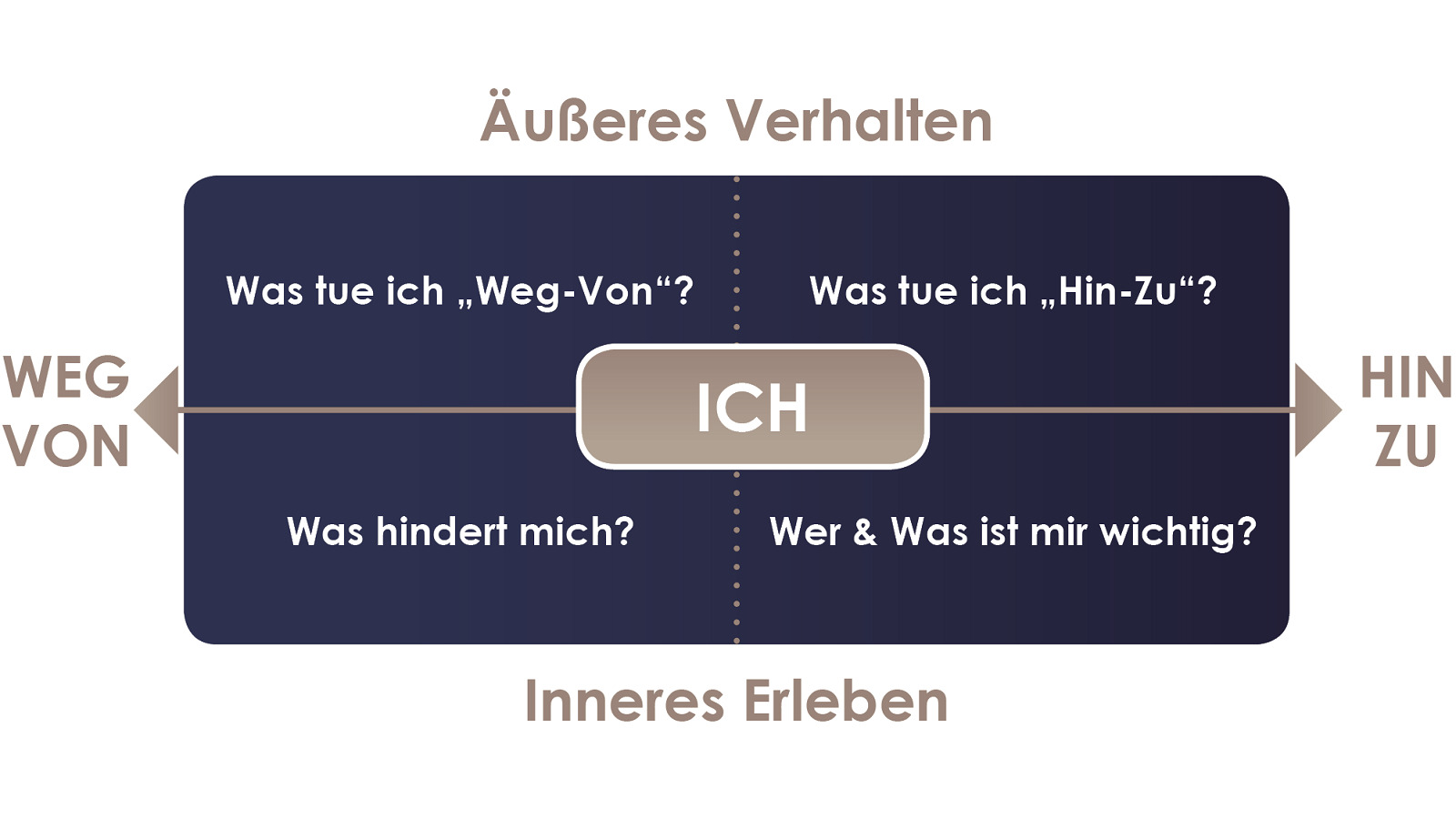
The ACT Matrix is a simplified yet highly effective model for increasing psychological flexibility without having to focus on all the core processes from the ACT hexagon. Its field of application ranges from advising, coaching and training to behaviour-based psychotherapy.
The diagram developed by Dr Kevin Polk from trauma therapy consists of two bisecting lines.
The vertical line represents experiences through our five senses (external) and mental activities (internal).
The horizontal line represents our behaviour in two directions: Away-From undesirable experiences and There-To important reference persons or life contents.
Together we will develop your personal Life Map and thus identify values, obstacles, avoidance strategies and opportunities for effective behavioural change.
You learn to communicate with your personal matrix and to categorise experiences in the respective quadrants.
Just one card can change your experience and behaviour in the long term. For a happier life.
Commitment instead of years of psychotherapy
In contrast to conventional talking therapies, we don't spend weeks talking about your problems, their origins and progression, the players involved and who is to blame.
Instead, we analyse where exactly you hooked and how you can get back on track unhook can.
Without commitment, goals & growth become unattainable. Therefore, you make a concrete and binding agreement with yourself as the basis of our therapy.
It would be irresponsible to predict the total duration of psychotherapy. It depends on many factors such as the duration, intensity and external conditions of your suffering as well as the resources available to cope with it.
Our Mental Health Consulting at EURASIAMED basically corresponds to short-term therapy, in which we regard each individual session as potentially the last. Our content is based on experience and knowledge and we develop concrete tasks to change your behaviour in everyday life.
Do you have any questions?
Psychotherapy can only be sustainably helpful if our relationship is harmonious, respectful and trusting. In a climate of openness, we can initiate profound changes in just a few sessions.
Feel free to call me if you have any questions before your initial consultation or would like to briefly describe your concerns. I am available on Wednesdays & Fridays from 14-18h.